Planting trees in an urban area may look…
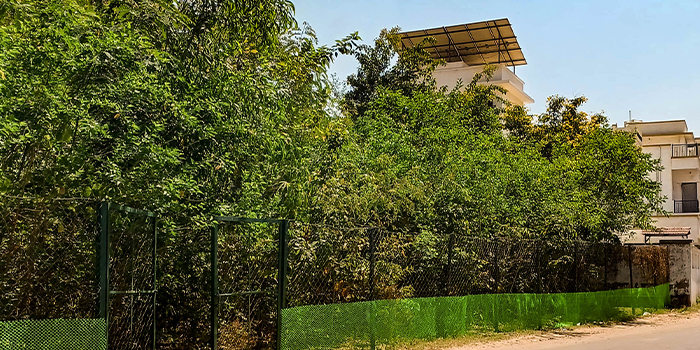
Urban Forest: Transform Unused Corporate Land
Unused corporate land is often treated as an empty space that may eventually be used for construction, parking, storage, or expansion. But not every open area needs to remain inactive until another project begins. With thoughtful planning, an unused plot can become an urban forest, a living environmental asset that adds ecological and social value to the property.
Such land development for an urban forest involves much more than planting trees in an area devoid of trees. It needs an understanding of the nature of the site, how it relates to the building, the natural landscape, flow of water, quality of soil, and type of ecosystem that may emerge in the site.
A Miyawaki method forest is just one among the options which an organization may consider for planting thick forests within limited areas of land. At the same time, each development needs to be planned in relation to its locality and not just as a plantation project everywhere.
For businesses, this approach can connect land management with afforestation, biodiversity improvement, corporate social responsibility CSR, and responsible carbon offset planning. More importantly, it can turn an overlooked part of a property into something that continues to provide value as it grows.
Start With the Purpose of the Land, Not Just the Plantation
Before planning an urban forest, the first question should be: What role should this land play in the future?
Corporate properties are rarely made up of one type of space. A campus may include buildings, roads, parking areas, utility zones, recreation spaces, drainage corridors, boundary areas, and unused plots. Some open spaces may remain available for future development, while others may have little practical use.
This distinction matters.
A suitable plantation area should have enough stability to support long-term ecological development. If the land is likely to be converted into a building or infrastructure project within a short period, establishing a permanent forest may not be the best decision.
Harmony Urban Forest approaches such planning by looking at the relationship between the proposed green area and the larger site. Instead of treating an urban forest as an isolated plantation, the land can be considered as part of the property’s overall environmental network.
This can create opportunities to connect existing trees, gardens, boundary greenery and open spaces with a new forested area.
The result is more meaningful than simply increasing the number of planted trees. The objective becomes creating a functional green space that belongs to the landscape.
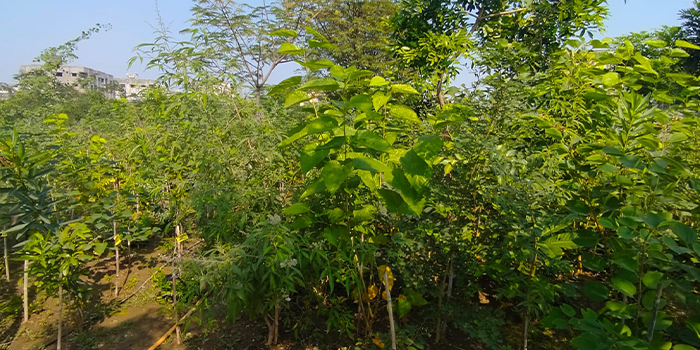
Turning an Empty Plot Into a Living Landscape
An unused corporate plot can often look disconnected from the rest of the property. Bare soil, construction debris, compacted ground or scattered vegetation may make the space difficult to use and visually unappealing.
A planned urban forest can change this relationship.
Instead of designing the area as a conventional decorative garden, an organization can develop a more natural vegetation system. A Miyawaki method forest may be considered where the land and ecological conditions are appropriate, particularly when the objective is to create dense native vegetation within a limited footprint.
The surrounding landscape should influence the design.
For example, a forest near an office building may require a different spatial arrangement from one located along an industrial boundary. A plantation beside a pedestrian pathway may need clear access zones, while a forest developed away from regular movement can be allowed to grow more naturally.
This is where landscape planning becomes important.
The trees should not be viewed separately from pathways, drainage, buildings, boundary walls and existing vegetation. The entire area can be planned as one connected landscape rather than as a collection of unrelated elements.
Such planning also helps the urban forest look more natural as it develops.
Main Types of Urban Forest
There are various types of urban forests, based on land availability, environment, and purpose of the plantation. These include Miyawaki style forests, community greenery areas, and business area landscaping. Selection of appropriate tree species, maintenance of balanced tree density, and conservation of biodiversity are some measures that can be taken for improving the environment.
1. Miyawaki Method Forest
The Miyawaki method forest consists of planting native trees, shrubs, and plants to form a forest having multiple layers. The Miyawaki method forest can be used in urban areas that require afforestation, biodiversity, and soil improvement.
2. Community Urban Forest
Urban forests in the community setting bring the trees close to home and other public places. They improve the scenery, increase the diversity of the surrounding area, and encourage community participation in environment conservation and tree planting activities.
3. Corporate Urban Forest
Urban forests for corporations are created within the corporate campuses and other suitable locations. These urban forests can help promote CSR activities, add value to the landscape, and create a sustainable environment in the future through tree plantation.
4. Roadside Urban Forest
Urban roadside forests consist of trees that are planted along roads and streets. With proper selection of the right plants, such plantations can serve as sources of beautification and shading for urban environments through appropriate landscaping.
5. Urban Park Forest
Forests in urban parks have trees and open green spaces that make them appear more natural in the urban setting. The planting of various plants is important for many reasons including biodiversity, landscape enhancement, and environmental education.
6. Riparian Urban Forest
Riparian urban forests are built close to water bodies such as rivers and streams. They involve planting trees that are suitable for the existing conditions of the soil and water, which aid in ecological restoration and environmental protection.
Choosing the Right Type of Urban Forest for Corporate Land
Choosing the correct plantation forest in urban areas is not limited to the plantation area available. Companies have to take into account the size of the plantation area, the soil condition, the availability of water, the presence of infrastructure and environmental goals. The Miyawaki method plantation forest may work well in some small plantation areas, while others may require roadside plantations, company green plantations, or ecological forests.
The objectives of the plantation project are also vital in the process of choosing the correct method for the company. Those companies that are concerned about biodiversity, soil development, land development, and CSR activities will need to choose from among the different methods depending on their specific needs. The density of the trees and the choice of native trees or fast-growing trees must depend on the actual plantation area.
At Harmony Urban Forest, we believe that every corporate property requires a thoughtful and site-specific approach to afforestation. By understanding the land and its future use, organizations can develop an urban forest which supports environmental improvement, integrates with the existing landscape, and creates long-term ecological value.
Making the Site Ready for Long-Term Growth
Planting is only one stage of creating a successful forest. The condition of the land underneath it can have a major influence on how vegetation establishes.
Corporate land may have been disturbed by construction, machinery movement, excavation, storage activity or years of neglect. Soil can become compacted, lose organic matter or have poor water movement.
This is where soil restoration becomes relevant.
The objective is not simply to make soil look fertile before plantation. It is to create a growing environment where roots can establish and where biological activity can gradually return.
Depending on the site, soil preparation may involve improving structure, organic content, drainage and moisture-holding capacity. The exact treatment should be based on site conditions rather than applying one standard mixture to every project.
Healthy soil also supports the wider ecosystem.
As vegetation develops, roots, fallen leaves, microorganisms and natural decomposition can gradually contribute to the site’s ecological recovery. In this way, soil restoration becomes part of the forest’s long-term development rather than a one-time preparation activity.
For degraded corporate land, this can make the difference between simply planting trees and genuinely improving the land.
Designing Tree Density Around the Site
Tree density is another area where planning should be based on the site rather than an arbitrary planting number.
A dense plantation can create a strong forest structure, but density should work with available space, soil conditions, species characteristics and the intended ecological outcome.
In a Miyawaki method forest, different layers of vegetation can be brought together to create a more complex structure. However, the selection should not focus only on fast growth.
Fast growing trees can help establish vegetation during the early stages, but a healthy forest also needs species that contribute to long-term stability, habitat value and ecological diversity.
This makes species selection a balancing exercise.
Some plants may establish quickly. Others may develop more slowly but become important components of the mature landscape. Combining appropriate species can create a forest that changes naturally over time instead of depending on one type of tree.
The purpose of tree density is therefore not simply to make a plantation appear crowded. It is to use available space intelligently while allowing different plants to contribute to the developing ecosystem.
Building Biodiversity Instead of Just Increasing Green Cover
A corporate plantation can contain hundreds or thousands of plants and still have limited ecological value if it lacks diversity.
Biodiversity should therefore be considered from the beginning.
A diversified urban forest can offer various forms of vegetation, food, and places to seek refuge for birds, butterflies, insects, and other organisms. The aim is to have relations formed between the plants and organisms rather than the relationship being between the tree itself.
Native plants are significant since they relate to the environment of the area. However, choosing native plants will not be easy because it will depend on factors such as the type of soil, weather, and availability of water.
This is also why a forest should not be designed only for its appearance during the first few months.
A newly planted area may look very different from the mature forest it eventually becomes. Some plants may grow quickly, while others gradually establish themselves beneath the developing canopy.
Over time, the landscape can become more layered and biologically active.
That gradual change is one of the most valuable characteristics of an urban forest: the project is designed to grow and evolve rather than remain visually fixed.
Integrating the Forest With Corporate Infrastructure
A common mistake is to place greenery wherever there is leftover space without considering how people use the property.
An urban forest should work alongside the existing infrastructure.
Corporate campuses can have pedestrian movement, employee gathering areas, service roads, parking spaces, security zones and emergency access requirements. Industrial properties may have operational restrictions, utility corridors and safety considerations.
The forest layout should respect these realities.
A green buffer can be placed where it provides separation between different areas. A plantation may help define the edge of a property without creating a completely closed landscape. Walking routes can be planned around appropriate areas rather than cutting through the developing forest unnecessarily.
This creates a more practical relationship between landscape and infrastructure.
The forest does not need to compete with the built environment. It can become part of it.
This approach also gives organizations greater flexibility when deciding where afforestation can realistically be implemented.
Making CSR More Meaningful Through Long-Term Land Use
For most firms, their CSR ventures are tied to a certain event – plantation day, employee activities, or community programs.
These may be good initiatives but the environmental aspect need not necessarily end at that point.
Creating an urban forest through utilizing the corporate land is one way to create a long-term CSR venture.
Employees can be involved in plantation and awareness activities while the urban forest will continue growing on its own even after the event.
There could be educational boards and biodiversity observation activities.
This gives CSR a visible physical presence.
Instead of showing only how many saplings were planted on one particular day, organizations can demonstrate how a piece of land has been progressively transformed into a functioning green area.
For companies with sustainability goals, this long-term perspective can make a plantation project more meaningful.
Connecting the Project With Carbon Offset Planning
An urban forest can also form part of a broader carbon offset strategy, but carbon benefits should be approached carefully.
Planting a particular number of trees will not necessarily equate to the company achieving a particular amount of carbon reduction or carbon credits because carbon results will be determined by elements like species, growth, survival, biomass accrual, project lifespan, and methodology among others.
Therefore, organizations should avoid treating tree counts as direct carbon numbers.
Instead, an urban forest can be viewed as one component of a wider environmental strategy that also includes reducing operational emissions, improving resource efficiency and protecting existing vegetation.
Where applicable standards and monitoring systems are used, plantation projects can contribute useful data to broader carbon accounting.
This makes the carbon offset discussion more credible because the environmental value is connected to actual project performance rather than assumptions.
Measuring What Happens After Plantation
The real story of an urban forest begins after planting.
Early monitoring can help identify plant survival, water requirements, weed pressure and areas that need attention. Over time, monitoring can become more focused on vegetation development, canopy formation, biodiversity observations and overall ecosystem condition.
Organizations can maintain a simple record of:
- Plantation area
- Number and diversity of plants
- Survival and growth
- Maintenance requirements
- Changes in vegetation structure
- Biodiversity observations
- Soil and landscape improvements
- Project photographs over different stages
This creates a visual and factual record of how the land changes.
For a corporate organization, such documentation can also make the project easier to communicate internally and externally. Employees, management teams, stakeholders and communities can see that the plantation is not being treated as a one-day activity.
It becomes a developing environmental asset.
Advantages of Converting Corporate Land Into an Urban Forest
1. Better Use of Underutilized Land
An unused plot can become a productive ecological space instead of remaining vacant. With suitable planning, the land can support vegetation, habitat and environmental improvement.
2. Stronger Landscape Integration
A forest can connect isolated green areas and make the overall property feel more naturally planned. It can become part of the campus landscape rather than an independent plantation patch.
3. Long-Term Biodiversity Value
A diverse plantation can provide habitat opportunities for different organisms and gradually develop greater ecological complexity as vegetation matures.
4. Opportunity for Soil Recovery
Where land has been degraded or compacted, appropriate soil restoration can create better conditions for vegetation while supporting the gradual recovery of biological activity.
5. A Visible CSR Asset
A long-term forest gives corporate social responsibility CSR activities a physical presence that employees and surrounding communities can see and engage with over time.
6. Support for Responsible Carbon Strategies
When properly measured and documented, an urban forest can contribute to broader environmental and carbon planning while complementing direct emission-reduction efforts.
7. A Landscape That Improves With Time
Unlike many conventional landscaping installations that are designed to maintain a fixed appearance, a forest becomes more developed as it grows. Its character changes with canopy development, seasonal variation and increasing biodiversity.
How Harmony Urban Forest Approaches Corporate Green Transformation
At Harmony Urban Forest, we believe that unused land should be evaluated according to its ecological potential rather than simply its present appearance.
Our design will take into account the study of the site and its environment, along with the future purposes of the green area proposed. Based on the location and goal of the project, we can consider options like urban forest, Miyawaki method forest, or any other afforestation concept.
The objective of our project is to plant a green area, which will harmonically blend in with the surroundings, along with promoting biodiversity.
Factors like condition of the land, soil, available area, vegetation, site utilization, and future needs will be taken into consideration for the plantation scheme. This helps avoid treating every corporate property in the same way.
For organizations interested in corporate social responsibility CSR, land restoration or environmental improvement, a forest can become more than a plantation project. It can become a long-term part of the property’s environmental identity.
Conclusion
The vacant land of corporate entities need not be left alone, simply because there is nothing on the land. If managed properly, this land could become an evolving ecological resource, which would add value to the landscape and provide a means for companies to contribute to environmental rehabilitation efforts.
A successful urban forest is not defined only by how many trees are planted. Its value comes from how thoughtfully the land is selected, how the soil is prepared, how tree density is planned, how species are combined and how the developing ecosystem is cared for.
A forest generated using the Miyawaki method might be a good choice for some particular compact spaces, whereas other places might need a different method of afforestation.
For companies, the chance is to move beyond the idea of afforestation only during one planting session. By properly utilizing the planning process of corporate social responsibility (CSR), by taking care of proper landscaping, and by making monitoring for many years ahead, unused land can become a part of the strategy of the company.
What would really change is transforming an empty space into a living space which will keep developing for many years.
Frequently Asked Questions
1. Can any unused corporate land be converted into an urban forest?
Not every plot is automatically suitable for an urban forest. The site’s soil condition, drainage, sunlight, available space, surrounding infrastructure, future development plans and environmental conditions should be assessed first. A suitable plantation strategy can then be developed according to the actual characteristics and long-term purpose of the land.
2. Is a Miyawaki method forest suitable for corporate properties?
A Miyawaki method forest can be suitable for certain corporate properties, particularly where organizations want dense native vegetation within a comparatively limited area. However, the method should be selected after understanding the site rather than assuming that the same model is appropriate for every location. Site-specific planning remains important for long-term success.
3. How does an urban forest differ from normal corporate landscaping?
Traditional landscaping often focuses strongly on appearance, maintenance and planned visual arrangements. An urban forest focuses more on developing a living ecological system. It can include multiple vegetation layers, diverse species and natural growth patterns. The objective is to allow the area to develop ecological value rather than simply maintaining a decorative green space.
4. Why is soil restoration important before plantation?
The corporate land could have had poorly structured soils from past development and other factors that would make them unfit for vegetation. The process of soil improvement will ensure a favorable environment for the plants in terms of structure, moisture, and other factors specific to the site.
5. Should fast growing trees be used in every urban forest?
No.Fast growing trees are very effective in the early stages of development, but the rate of growth is not the only criteria for choosing plants. An ideal plantation would be the one that takes into consideration indigenous plants, ecological balance, development, and other aspects of the place.
6. Can corporate social responsibility CSR funds be used for an urban forest project?
Organizations may consider suitable plantation and environmental restoration projects within their corporate social responsibility CSR planning, subject to applicable CSR rules and project eligibility. A long-term forest project can provide a physical environmental asset rather than limiting CSR involvement to a one-day plantation event. Proper planning and documentation can also make the initiative easier to monitor.
7. Can an urban forest be included in a company’s carbon offset strategy?
It can potentially contribute to a broader carbon strategy, but organizations should not automatically equate the number of planted trees with carbon credits or verified offsets. Carbon outcomes depend on project-specific data, methodology, monitoring and applicable standards. Plantation should complement, rather than replace, direct efforts to reduce operational emissions.
Related Posts